



More accurate LLMs and VLMs, at a lower cost.
AgentCodec sits in front of your LLMs and VLMs and applies advanced reasoning: combining multiple models, cross-checking their answers, and picking the right models and technique for each prompt, so answers are more accurate and consistent at lower cost. You configure it once; your app just calls a single endpoint (optionally OpenAI-compatible). AgentCodec is available now in the AptAgents Platform.
7-day free trial · From $25 per seat per month
See the results ↓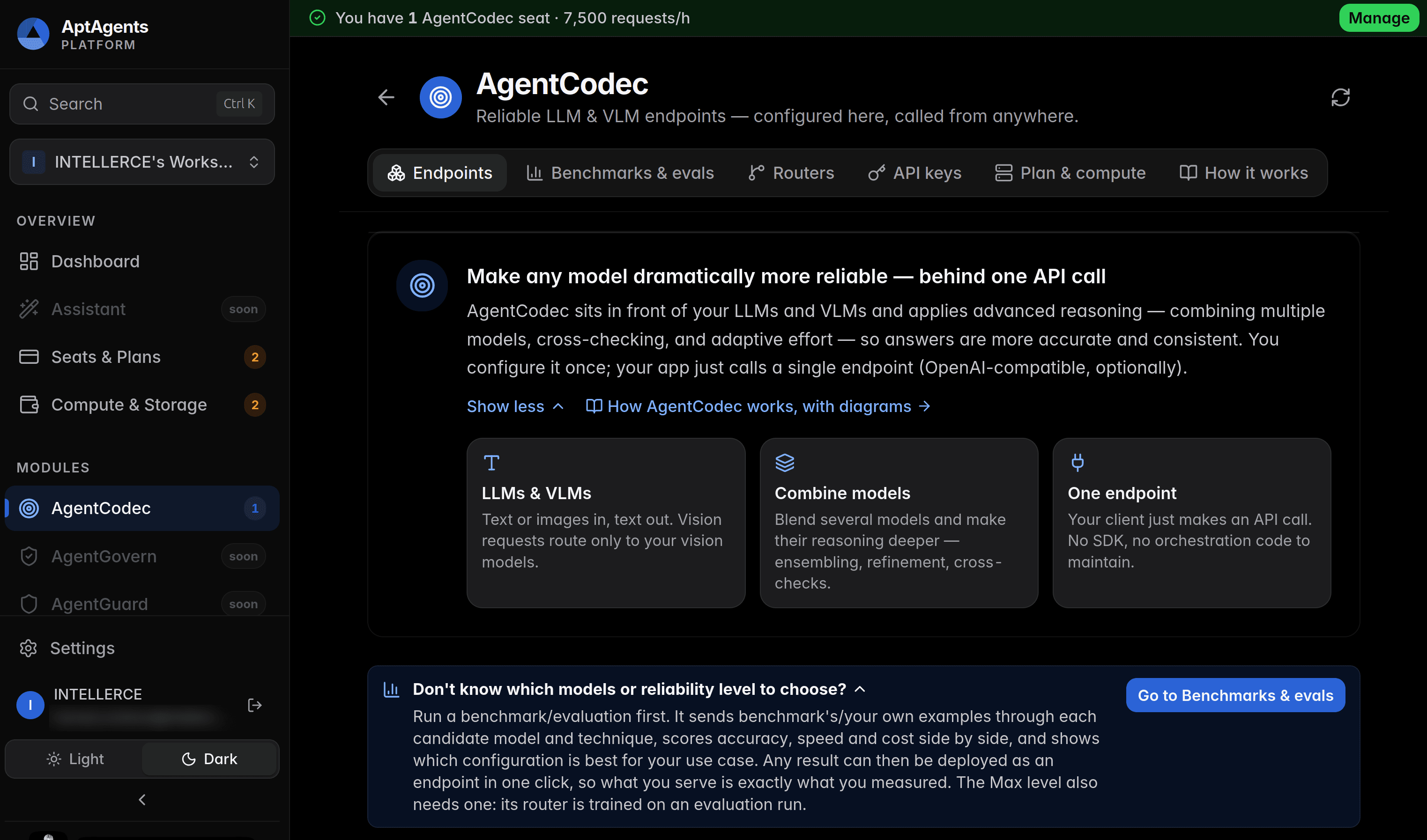
Advanced reasoning, made routine.
LLMs & VLMs
Text or images in, text out. Vision requests route only to your vision models.
Combine models
Blend several models and make their reasoning deeper: ensembling, refinement, cross-checks.
One endpoint
Your client just makes an API call. No SDK, no orchestration code to maintain.
Watch it run.
This is AgentCodec inside the AptAgents platform, where a reliability technique wraps your LLMs and VLMs behind one endpoint your app calls like any other model API. No SDK to adopt, no orchestration code to maintain.
Reliability you can budget for.
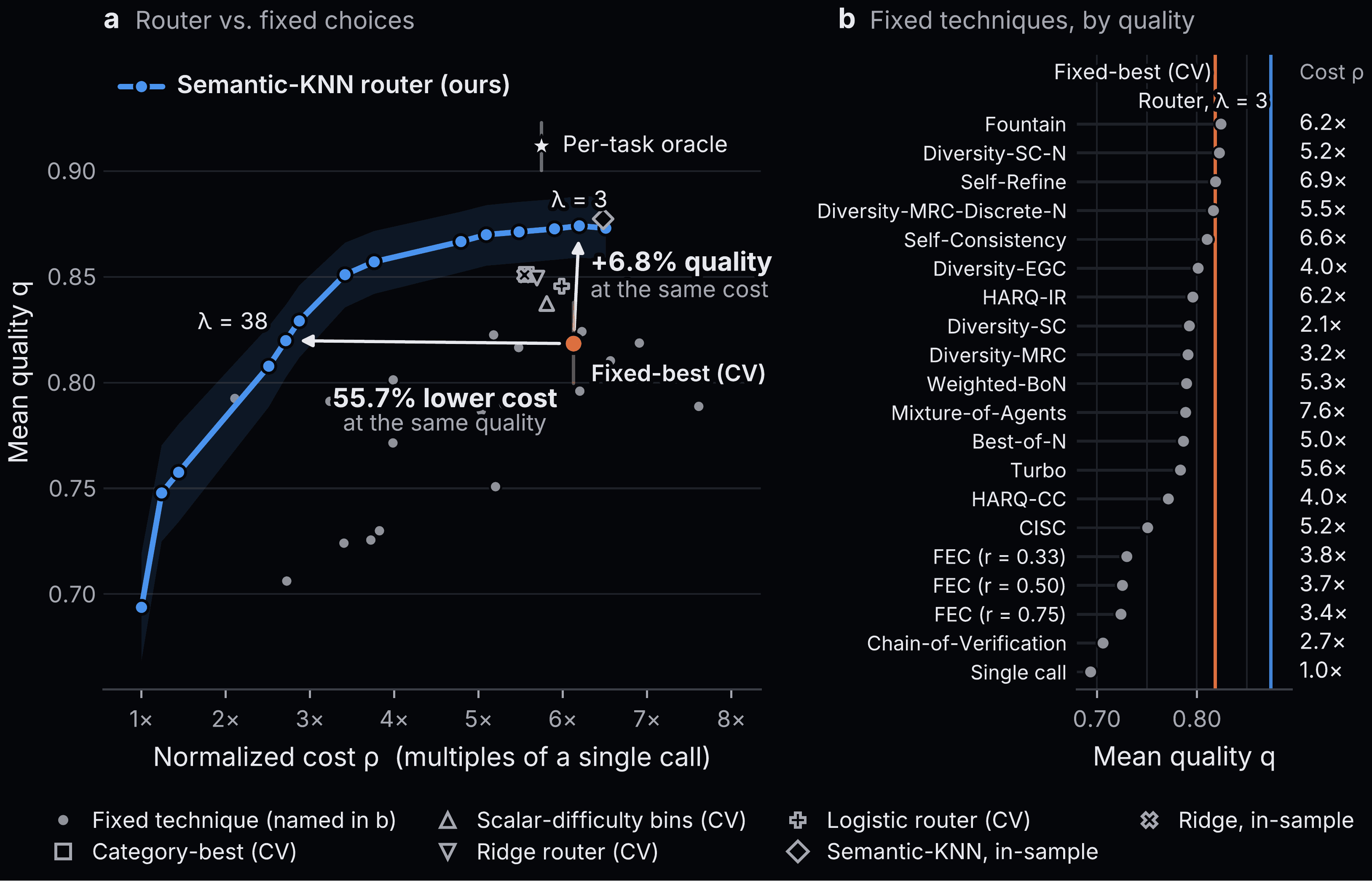
AgentCodec can combine your models so that, together, they answer more accurately than any one of them alone. Routing the technique adaptively per prompt does better still. On our paper benchmark, the router cut LLM cost by 56% at the same quality as the best fixed technique, beat that technique's quality by 6.8% at the same cost, and scored up to 26% higher than a single model call. Savings on your workload depend on your models and prompts. A single knob, λ, slides the operating point along the cost/quality frontier, so you decide how much reliability to buy.
Better answers with images in the loop.
The same coding schemes run over vision-language models inside AptAgents. On the MMMU multimodal benchmark, combining vision-language models traced an accuracy frontier above every single model on its own, peaking at 87.2% accuracy, scored by exact match against the reference with no judge in the loop. Our vision-language work is still in progress, so treat these results as preliminary.
6 families. 21 techniques.
21 communication-theoretic methods span these 6 families, each a coding scheme over the noisy channel that is an LLM. They generalize self-consistency, self-refine, and chain-of-verification, and outperform them on our benchmark.
Diversity Combining
N parallel branches across different models (spatial), prompt variants (frequency), or temperatures (time), combined by maximal-ratio, selection, or equal-gain. Generalizes self-consistency, best-of-N, mixture-of-agents.
Hybrid ARQ
Retry until quality clears the threshold. HARQ-IR adds new critic hints each round; HARQ-CC soft-combines every attempt into one quality-weighted answer. Generalizes self-refine and Reflexion.
Turbo Decoding
Generator drafts, critic returns structured extrinsic information, generator re-drafts on that feedback until convergence. Generalizes generator–critic and self-critique loops.
Fountain
Keep generating samples until the judge is satisfied. Easy prompts finish fast; hard prompts get more samples automatically. Generalizes universal self-consistency and dynamic-N voting.
Forward Error Correction
A systematic block code: a primary answer plus parity sections (reasoning, verification, alternatives). The decoder cross-checks for consistency and reconstructs the corrected answer. Generalizes chain-of-verification.
ACM + SemKNN Routing
Route per-prompt by estimated difficulty. The SemKNN router learned which technique wins for which kind of prompt; a single knob λ trades quality for cost along the frontier.
7 prior-method baselines bring the reliability set to 28; with an uncoded single-pass baseline, that's 29 dispatchable techniques in all. Benchmark them head-to-head:
SemKNN: cost-aware, per-prompt.
SemKNN learned from benchmark data which models and technique work best for which kind of prompt. For each new prompt, it recommends which models to call and which of 28 techniques to run. Easy prompts take a cheaper model and a light technique; hard prompts get stronger models, retries, and cross-checks.
One knob, the whole frontier
- λ = 0Pure quality: ignore cost entirely.
- λ = 1Balanced operating point.
- λ = 5Cheaper picks at near-matched quality.
- λ = 10Cheaper still.
- λ = 20Lowest cost.
Privacy & data flow
- Your prompts, data, and benchmark results stay inside the platform.
- Prompts go only to the models in your endpoint.
- For sensitive workloads, deploy your own private LLMs and VLMs easily on the platform.
- Enterprise customers can run the whole platform inside their own network by arrangement.
Every dollar is labeled.
AgentCodec never hands you a cost number without telling you how it got there. Each estimate carries a tier from a fixed enum, ranging from exact per-token rates you configured down to a parameter-count guess from the model name, so you always know how loose the accounting is.
Tiered estimates
exact_user_rate → openrouter_rate → fuzzy → table → inferred. Lower tier = tighter accounting. The worst tier across all calls is surfaced on the result.
Full per-run trace
Every run records input, output, and thinking tokens, per-call cost, judge cost, the number of LLM calls, and the cost-source breakdown.
Live rate catalog
Unknown models are priced against the OpenRouter catalog using exact and fuzzy matching, with explicit caveats when caching or volume discounts aren't modeled.
An endpoint, not a framework.
No new agent abstraction to adopt and nothing to install. Your app keeps its code, calls one endpoint, and gets reliability, evaluation, and cost accounting as a hosted layer underneath.
One endpoint
Call it like any other model API, optionally OpenAI-compatible. The technique is configured on the endpoint, not in your code.
Native async streaming
27 of 29 techniques stream natively end-to-end. Per-token deltas carry role tags so you can demux drafts, critiques, and the final answer live.
Evaluations & benchmarks
Benchmark models and techniques on standard or private datasets, with confidence intervals and paired significance tests. Every run reports quality, accuracy, a blended score, and cost.
Hosted for you
AptAgents runs AgentCodec as a hosted service, so there is nothing to install or operate. Enterprise customers can run it inside their own network by arrangement.
Privacy by design
Your data stays in the platform and goes only to the models you choose. For sensitive workloads, deploy your own private LLMs and VLMs easily on the platform.
Provider-agnostic
Frontier APIs, OpenRouter, or your own private LLMs and VLMs, deployed easily on the platform. Mix model families in one lineup: uncorrelated errors are exactly what diversity combining wants.
The technical picture.
AgentCodec wraps every model call in a technique drawn from classical communication theory: HARQ, diversity combining, FEC, turbo decoding, and the cost-aware SemKNN router. 28 reliability techniques (21 communication-theoretic methods across 6 families plus 7 prior-method baselines), an uncoded baseline for reference (29 dispatchable in all), and 3 adaptive routers on top. In AptAgents, it serves both language and vision-language models behind a single endpoint.
Available now in the AptAgents Platform.
AgentCodec ships as the reliability layer of the AptAgents Platform, our hosted agentic AI platform. It works with both language and vision-language models, behind one endpoint your app calls like any other model API. The paper behind it has been accepted at NeurIPS 2026, and the preprint is available on arXiv.
- Text or images in. Vision requests route only to your vision models.
- One OpenAI-compatible endpoint behind one workspace key.
- Mix and match models, and variants of the same model, in one endpoint: ensembling, refinement, cross-checks.
- Evaluations and benchmarks on standard or private datasets that report quality, accuracy, a blended score, and cost, so you can find the best models and technique for your task.
- Train your own SemKNN router or ACM table from your benchmark results.
- Monitor cost on every call, and optimize for cost or for accuracy.
Hosted by default. Enterprise customers can run it inside their own network by arrangement.
Bring AgentCodec to your agents.
AgentCodec is available now in the AptAgents Platform: communication-theoretic reliability for your LLMs and VLMs, behind one endpoint. Tell us about your use case, and we will walk you through it.